
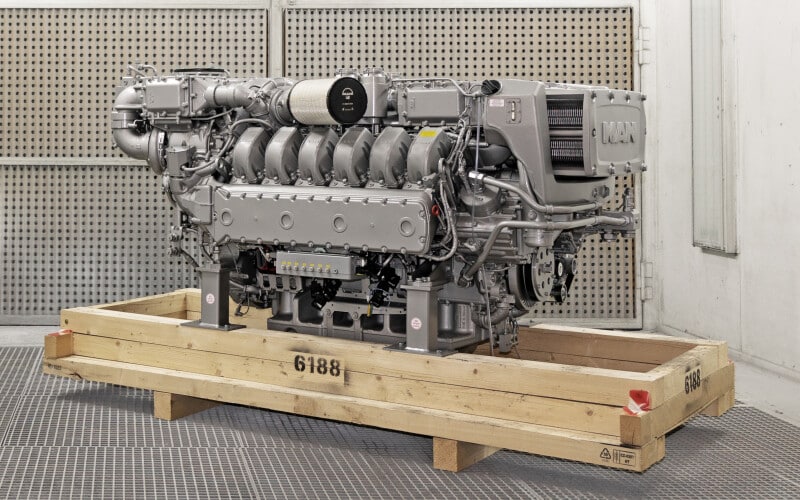
Walk the engine room of a large cargo vessel and the complexity of the lubrication system becomes immediately apparent. Unlike a car or a truck, a marine engine has multiple lubrication circuits that require completely different types of oil — and mixing them up can cause catastrophic damage. Understanding the difference between cylinder oil, system oil, and crankcase oil is fundamental for anyone involved in marine operations.
2-Stroke Crosshead Engines (Large Ships)
The large low-speed 2-stroke diesel engines (MAN, WinGD/Wärtsilä) used in cargo ships, tankers, and bulk carriers have two separate lubricant circuits. Cylinder oil is injected directly into the cylinder liner to lubricate piston rings and the liner surface. It is consumed with combustion and must be replenished continuously. Modern cylinder oils are high-BN (Base Number) — typically BN 40–100 — to neutralize sulphuric acid formed by sulphur in the fuel. With low-sulphur fuels (VLSFO), lower BN cylinder oils are appropriate. System oil lubricates the main bearings, crosshead bearings, camshaft, and turbocharger. It circulates in a closed system and is much longer-lived than cylinder oil.
4-Stroke Trunk Piston Engines (Smaller Vessels, Gensets)
Medium-speed 4-stroke engines (used in smaller cargo ships, ferries, fishing vessels, and generator sets) use a single crankcase oil that lubricates all engine components. This oil must perform multiple functions simultaneously: lubricating crankshaft bearings, pistons, and valve gear; cooling piston crowns; neutralizing combustion acids; and keeping the engine clean. Marine 4-stroke engine oils are typically SAE 30 or SAE 40, with BN ratings matched to the sulphur content of the fuel used.
Turbocharger Oils
Marine diesel engines — both 2-stroke and 4-stroke — use turbochargers that spin at very high speeds under extreme temperatures. The turbocharger bearings are typically supplied from the engine’s main oil system, but the oil must be kept clean and at the correct viscosity. Turbocharger bearing failures are often caused by oil contamination or oil supply interruption — routine monitoring of main engine oil quality is essential.
Marine Compressor Oil
Starting air compressors on ships compress air to 25–30 bar for engine starting. The compressor oil must resist oxidation at the elevated discharge temperatures of reciprocating compressors, have good water separation, and prevent carbon deposit formation in discharge valves — a leading cause of compressor fires. ISO VG 100 or 150 mineral-based or synthetic compressor oils are standard.
📞 CONTACT & CTA
Lukeron Lubricants supplies full marine engine oil ranges for Indian vessels. Contact: +91 73832 79438 | sales@lukeronlubricants.com